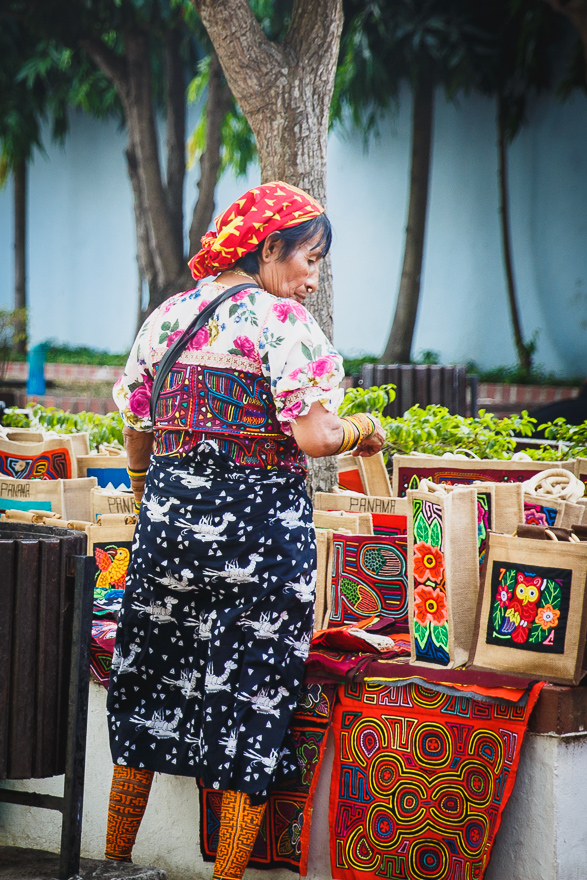
The Guna, at 60,000 members, represents the largest indigenous group in Panama and populate the 360 islands in the San Blas archipelago and the narrow strip on the Caribbean coast of Panama and Columbia. A traditionally matriarchic society women support the community by making and selling molas.
Geometric patterns have been used for body painting since ancient times. After the arrival of the Spanish and access to fabric the Guna transferred their motifs onto textiles creating the molas. Molas are hand-made, multi-layered cotton panels with complex designs achieved through applique, reverse-applique and embroidery. Las molas naga are panels with a protective power for the woman that wears them. They are characterized by abstract, geometrical designs inspired by nature. Molas can also be designed with figural representations and scenes of everyday life.
While in Panama we visited Museo de la Mola which gave us a great perspective on the history, meaning and beauty of the molas.

 The American Trade Hotel’s building dates back to 1917 and was the headquarters for the American Trade Developing Company. At the time it was the first skyscraper in Panama. After World War II, the neighborhood started its decline and by the 1970s the building was abandoned and vandalized. Before being bought by a development firm in 2007, it was the headquarters of the Pentágono gang. The abandoned building used to be a crack house called “Castillo de Greyskul”. Some of the old gang members have been rehabilitated and work in the hotel.